
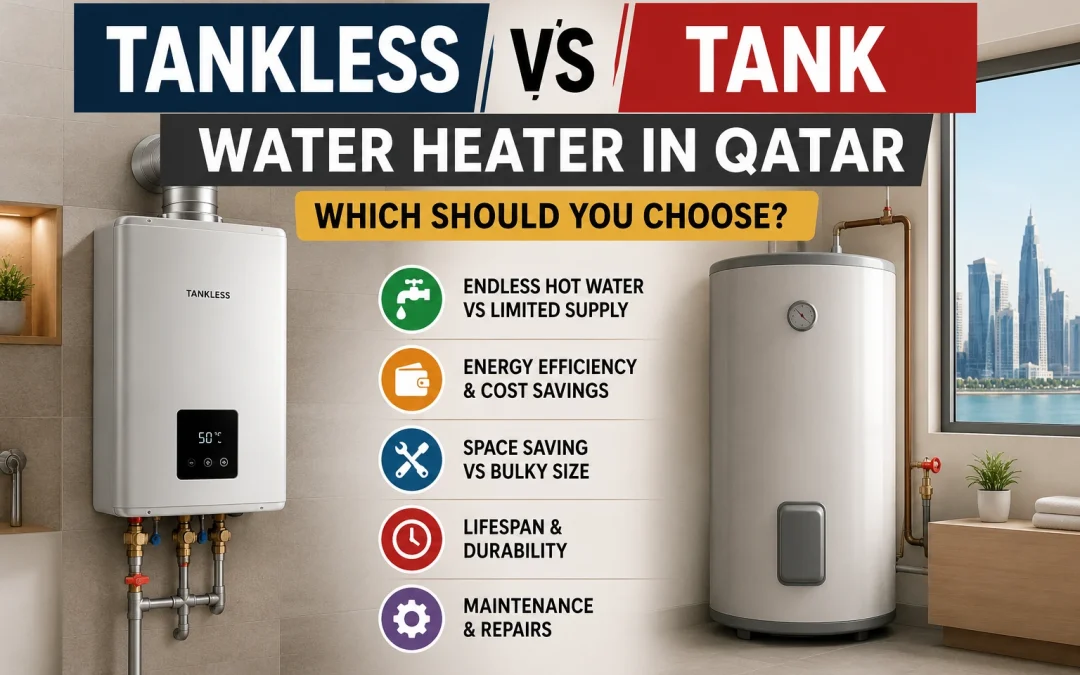
If you’ve ever stood in a hardware store in Doha — or scrolled through options online at midnight because your old water heater finally gave up — you’ve faced this question: tankless or tank?
Both work. Both are widely used across Qatar. But depending on your household size, your daily routine, your property type, and how long you plan to stay in your current home, one option will serve you significantly better than the other.
This isn’t a generic guide. It’s written specifically for Qatar’s residential context — the heat, the water quality, the typical villa and apartment configurations, and the energy costs you’re actually dealing with.
Let’s break it down properly.
What’s the Actual Difference Between the Two?
Before the comparison, a quick grounding in how each system works, because the difference in mechanism explains almost every performance difference that follows.
How a Tank Water Heater Works
A tank water heater stores a fixed volume of water — typically 50 to 200 litres — and keeps it heated continuously, ready for use at any time. When you open the hot tap, pre-heated water flows out. As the tank drains, cold water refills it from the bottom and begins heating again.
The heating element (electric) or gas burner runs in cycles throughout the day and night to maintain the water at your set temperature — typically 55–60°C to prevent bacterial growth.
How a Tankless (Instant) Water Heater Works
A tankless water heater — also called an on-demand or instant water heater — has no storage tank. When you turn on the hot tap, cold water passes through a heat exchanger inside the unit, which heats it in real time using an electric element or gas burner. The moment you close the tap, heating stops.
No stored water. No standby heat loss. Hot water for as long as water flows through the unit.
Comparing the Two: What Matters Most in Qatar
1. Energy Efficiency
This is where tankless systems have a clear advantage — and it matters more in Qatar than most places.
A tank water heater runs its heating element or burner continuously to maintain water temperature, even at 3 am when no one is using it. This is called standby heat loss. In cooler countries, it’s a minor inefficiency. In Qatar, where ambient temperatures can exceed 45°C outdoors but indoor rooms are heavily air-conditioned, the dynamics shift — but you’re still paying to heat water around the clock regardless of usage.
A tankless system eliminates standby loss. It only consumes energy when you actually use hot water.
Energy savings with tankless: According to ASHRAE guidelines, on-demand water heaters typically use 24–34% less energy than conventional storage units in households with moderate daily hot water usage. In larger households with very high usage, the gap narrows slightly — but a tankless unit still comes out ahead.
Qatar context: Qatar’s electricity tariffs for residential users are heavily subsidized, which means the monthly savings from a tankless unit are meaningful but not dramatic in pure QAR terms. However, over a 10–15 year lifespan, the efficiency advantage does add up — and it’s the environmentally responsible choice regardless.
Winner: Tankless
2. Hot Water Supply — Will You Run Out?
This is where tank systems have a real-world advantage that’s easy to underestimate.
A 150-litre tank water heater provides a consistent reserve of hot water. For a family of four, that typically covers back-to-back morning showers, kitchen use, and some cleaning without any issue. If the tank runs low, it takes 20–40 minutes to fully reheat.
A tankless system heats water continuously — so theoretically, you never run out. The limitation is flow rate: most residential tankless units can only heat water fast enough to supply 1–2 points simultaneously. If you’re running a shower and someone turns on the kitchen tap for hot water at the same time, a single standard tankless unit may struggle to keep both at full temperature.
Qatar-specific consideration: Many villas in Doha have 3–4 bathrooms plus a kitchen and laundry. Running a single mid-range tankless unit across all those points isn’t realistic. Either you install a high-capacity unit (higher upfront cost) or multiple smaller units at different points of use.
Apartments and smaller homes with 1–2 bathrooms are well-suited to standard tankless units. Larger villas with high simultaneous demand may find a well-sized tank system — or a combination approach — more practical.
Winner: Tank (for large households), Tankless (for small to medium homes)

3. Upfront Cost and Installation
There’s a meaningful price difference here, and it’s worth being honest about it.
Tank water heaters are straightforward to install and widely available in Qatar. A good quality electric storage unit suitable for a family home — brands like Ariston, Rheem, and Daikin are common in Doha — typically costs between QAR 300–900 for the unit, with standard installation adding QAR 150–350.
Tankless water heaters cost more upfront. A quality electric instant unit for single-point use starts around QAR 400–700. A whole-home gas tankless system from a reputable brand can run QAR 1,200–3,500+, and installation is more involved — especially for gas units, which require proper ventilation and gas line work by a certified technician.
For renters: If you’re renting in Qatar and plan to move in the next 1–2 years, the lower upfront cost of a tank unit often makes more financial sense — unless your landlord agrees to contribute to a tankless installation.
For villa owners and long-term residents: The higher upfront cost of tankless is typically recovered over 5–8 years through energy savings, and the longer lifespan (see below) means fewer replacement cycles.
Winner: Tank (upfront cost), Tankless (long-term cost of ownership)
4. Lifespan and Maintenance
Water quality in Qatar is worth factoring in here. Doha’s water supply is desalinated, which means it’s relatively low in minerals compared to hard water regions, but it can still affect tank components over time, particularly the anode rod in storage tanks, which corrodes to protect the tank lining.
Tank water heaters typically last 8–12 years in Qatar with proper maintenance. Key maintenance tasks include flushing sediment annually, replacing the anode rod every 3–5 years, and checking the pressure relief valve. Neglected tanks corrode from the inside out — and often fail suddenly rather than gradually.
Tankless water heaters last considerably longer — typically 15–20 years — because they have no standing water to cause internal corrosion. The main maintenance requirement is periodic descaling of the heat exchanger, which is especially relevant given Qatar’s water supply. Annual servicing by a qualified plumber is recommended.
Winner: Tankless (longer lifespan, lower long-term maintenance cost)
5. Space Requirements
This is a practical point that matters more in apartments than in villas.
A tank water heater — even a 100-litre unit — takes up noticeable space. In apartment utility rooms, this can be a real constraint. Larger 150–200 litre tanks are bulky and typically installed in dedicated cupboards or outdoor utility areas.
Tankless units are compact. A standard electric instant heater is roughly the size of a small suitcase and can be wall-mounted near the point of use — under a sink, in a bathroom corner, or in a kitchen cabinet. They take up a fraction of the space.
Winner: Tankless
6. Comfort and Consistency
A well-maintained tank heater provides reliable, consistent hot water at a stable temperature. There are no delays once the tank is full.
Tankless units can occasionally experience a brief cold water “sandwich” — a small burst of cooler water at the start of the flow, caused by the heat exchanger taking a moment to reach operating temperature. In practice, most modern units compensate for this effectively, but it’s worth knowing.
Gas tankless units generally perform better than electric tankless units at maintaining consistent temperatures across variable flow rates. Electric tankless units can fluctuate slightly more in temperature when the flow rate changes.
Winner: Tank (slight edge for consistency), Tankless (no waiting for reheat after heavy use)
Which Water Heater Type Suits Which Qatar Home?
Rather than a universal answer, here’s a practical breakdown by household type:
Studio or 1-bedroom apartment → Tankless electric instant heater at each point of use. Compact, efficient, low running cost.
2–3 bedroom apartment → Either a mid-capacity tank (100–120 litres) or a quality whole-home tankless unit. Tankless is preferred if the installation supports it.
Small villa (3–4 bedrooms, moderate usage) → Whole-home gas tankless or a large tank (150–200 litres). Gas tankless if the property has a gas supply already.
Large villa (5+ bedrooms, high simultaneous usage) → Large capacity tank system, or a combination of a central tank plus tankless units at secondary points. Full tankless coverage for a large villa requires a high-flow system and a proper installation assessment.
Rental property (tenant perspective) → Replace like-for-like unless the landlord agrees to upgrade. A basic tank replacement is quicker, cheaper, and causes less disruption.
A Note on Solar Water Heaters in Qatar
Some homeowners in Qatar consider solar water heaters, and given that Qatar receives abundant sunlight year-round, the energy case is strong. A solar unit with an electric backup element can reduce water heating costs by 60–70% over a conventional tank system.
However, solar units require roof access (typically villa only), a larger upfront investment, and careful installation to handle Qatar’s summer heat without overheating the system. They’re worth a separate evaluation if you own your property long-term.
Summary: Tankless vs Tank at a Glance
| Factor | Tank Water Heater | Tankless (On-Demand) |
| Upfront cost | Lower (QAR 300–900) | Higher (QAR 400–3,500+) |
| Energy efficiency | Lower (standby loss) | Higher (no standby loss) |
| Hot water supply | Limited by tank size | Continuous (flow rate limited) |
| Lifespan | 8–12 years | 15–20 years |
| Space needed | Large | Compact |
| Maintenance | Annual flush, anode rod | Annual descaling |
| Best for | Large families, high simultaneous demand | Small–medium homes, efficiency-focused |
Need Help Choosing or Installing a Water Heater in Doha?
The Doha Home Fix plumbing team can assess your property, recommend the right unit for your specific needs, and handle installation to the correct standard. No guesswork, no overselling — just honest advice and solid workmanship.
Find us on Google Maps: Doha Home Fix 🌐
Don’t wait until your current unit fails. Book a free consultation today.
Doha Home Fix provides professional plumbing, AC, carpentry, electrical, and general home maintenance services across Doha and Qatar.
Conclusion
There’s no universal winner between tankless and tank water heaters in Qatar — there’s only the right answer for your specific home, household size, and situation. For most apartments and medium-sized homes, a quality tankless system is the smarter long-term investment. For larger villas with high simultaneous demand, a well-sized tank system remains genuinely practical.
What matters most is getting the right unit correctly installed and properly maintained — because in Qatar’s climate, a poorly installed or neglected water heater will underperform regardless of which type it is.
Frequently Asked Questions
Is a tankless water heater worth it in Qatar, given the low electricity tariff?
Even with subsidized electricity, the longer lifespan and lower maintenance of tankless units make them cost-effective for homeowners planning to stay long-term. The energy saving is a bonus, not the only reason to choose it.
Can I install a tankless water heater in a Qatar apartment myself?
Electric instant units at single points are relatively straightforward. Gas tankless systems and whole-home electric installations must be done by a licensed plumber, as required by Qatar’s building regulations.
How do I know what size tank or tankless unit I need for my home in Doha?
A rough guide: allow 35–40 litres of tank capacity per person for storage units. For tankless, calculate peak simultaneous demand in litres per minute across your busiest usage points. A qualified plumber can assess your property and recommend the right specification.
By the Doha Home Fix Technical Team