

By the Doha Home Fix Interior Furnishings Team | Updated: June 2026 | Reading Time: 8 minutes
Walk into any large villa in Al Waab or a high-rise apartment in Lusail, and you’ll notice something immediately — the spaces are either unusually large, unusually narrow, or arranged in ways that make standard furniture look awkward and out of place.
A sofa that fits perfectly in a showroom in Europe or a catalog from a global furniture chain rarely translates well to the proportions of a Doha living room. The majlis-style sitting areas common in Qatari villas demand wide, low-profile seating. Open-plan apartments in The Pearl need furniture that defines zones without blocking sight lines. And floor-to-ceiling windows — a staple of modern Doha architecture — require curtains that are cut, lined, and hung with precision, not folded into a box and assembled with a hex key.
This is the core reason custom sofa and curtain making has become one of the most requested home interior services in Doha. It is not a luxury — it is a practical response to the reality of how homes in Qatar are actually built and lived in.
What Custom Sofa Making in Doha Actually Involves
Many homeowners assume custom sofa making is a premium service reserved for high-end interior design projects. In practice, a bespoke sofa commissioned through a skilled craftsman in Doha is often comparable in price to mid-range imported furniture, with the significant advantage of being built to your exact dimensions, comfort preferences, and fabric choice.
Here is what a proper custom sofa build covers from start to finish.
The Frame
A quality sofa frame is the foundation on which everything else depends. Reputable custom sofa makers in Qatar use kiln-dried hardwood or engineered timber for the frame — materials that resist warping and cracking in Qatar’s temperature-fluctuating environment, where interiors can swing from heavily air-conditioned to warm within short periods.
Avoid any workshop that uses green or untreated timber, softwood, or particleboard for load-bearing frame components. These materials may look fine initially, but will weaken, creak, and fail within a few years under regular use.
The Suspension System
The suspension — the layer between the frame and the foam — determines how the sofa feels underfoot and how well it holds its shape over time. The two main systems used in custom work in Doha are:
Sinuous spring suspension uses S-shaped steel springs across the seat base. Durable, widely used, and suitable for most residential applications. A well-tensioned sinuous spring system gives a firm but comfortable seat.
Eight-way hand-tied springs are the traditional higher-end method, where individual coil springs are tied in eight directions to the frame. More labor-intensive and more expensive, but it produces a livelier, more responsive seat that typically outlasts sinuous systems by years.
For most homes in Doha, a quality sinuous spring system is perfectly sufficient. If you are commissioning a large, statement piece for a formal sitting area — particularly a majlis-style arrangement — eight-way hand-tied is worth the additional cost.
The Foam and Filling
Foam density is measured in kilograms per cubic metre (kg/m3). For seat cushions in a regularly used sofa, a density of 30–40 kg/m3 is the standard range. Below 28 kg/m3, and you will notice visible compression within six to twelve months. Above 40 kg/m3 produces a firmer seat that some people prefer.
Qatar’s climate is worth considering here. High-density foam retains heat more than lower-density options — a relevant factor in a country where rooms are heavily air-conditioned but people still feel the temperature difference when seated.
Some workshops in Doha use shredded foam or low-grade fillings in back cushions as a cost-cutting measure. Always ask specifically what is being used for both seat and back cushions before signing off on a quote.
Fabric Selection
This is where most clients spend the most time — and rightfully so, because the fabric defines the final look and determines how well the sofa holds up over the years.
For homes in Doha, the relevant considerations are:
Durability rating (rub count): Fabrics used in upholstery are tested by the Martindale or Wyzenbeek method, which measures how many rubs a fabric can withstand before showing wear. For a primary living room sofa with regular use, aim for at least 25,000 Martindale rubs. High-traffic family sofas benefit from 40,000 or more.
Fade resistance: Direct sunlight through Qatar’s large windows will fade most fabrics over time. Solution-dyed fabrics, where color is added to the fiber before weaving rather than printed on top, offer significantly better fade resistance. This is particularly relevant for light-colored linens and cotton weaves near sun-facing windows.
Cleanability: For households with children and frequent guests, and given the cultural importance of hospitality in Qatar, a sofa fabric that can be easily spot-cleaned is a practical priority. Performance fabrics — a category that includes stain-treated velvets, solution-dyed acrylics, and technical weaves — are increasingly popular in Doha for this reason.
Texture and cultural context: In Qatar’s interior culture, texture carries significant visual weight. Rich textures — boucle, velvet, thick linen blends, and jacquard weaves — read as considered and quality-conscious. Plain polyester or thin printed fabrics tend to look insubstantial in larger rooms.
What Custom Curtain Making in Doha Covers
Curtains are not an afterthought in Doha home interiors. They are structural and functional elements — blocking intense direct sunlight, providing privacy in high-rise settings, managing heat gain through floor-to-ceiling glass, and anchoring the visual weight of large rooms.
A custom-made curtain from a skilled workshop in Doha is a different object entirely from a ready-made panel sold in a home goods store.

Measuring and Fabric Calculation
Custom curtain making begins with precise measurement — not of the window opening, but of the track or pole position, the floor-to-ceiling height, and the stacking space available on either side of the window when the curtains are open.
A common mistake in DIY curtain installation in Doha is hanging curtains that are the exact width of the window. Curtains that look full and properly dressed typically use 2 to 2.5 times the track width in fabric. A 3-metre-wide window in a living room needs 6 to 7.5 metres of fabric across both panels to hang with proper fullness. A skilled curtain maker calculates this automatically; a ready-made panel from a retail shelf does not.
Heading Styles
The heading is the top of the curtain — the section that attaches to the track or pole and determines the pleat style and silhouette.
The most common heading styles used in Doha residential properties are:
Pinch pleat — a classic triple-fold pleat that creates a structured, formal appearance. Suitable for traditional and transitional interiors, majlis areas, and formal dining rooms.
Eyelet (grommet) heading — a contemporary ring-top style that creates soft, regular folds. Popular in modern apartments in Lusail and West Bay. Easy to operate and visually clean.
Pencil pleat — a tighter, more uniform gather than pinch pleat. Versatile and widely used across interior styles. Works with both hooks and specialized tracks.
Wave heading — produces a continuous S-curve fold when hung, giving an architectural, minimal appearance. Used in contemporary villas with large windows and high ceilings. Requires a specific glider track to function correctly.
Lining and Interlining
In Qatar’s climate, a lined curtain is not optional for any window facing direct sunlight. A blackout lining blocks light entirely — essential for bedrooms and particularly relevant for night-shift workers and families with young children. A thermal lining reduces heat gain through glass, which directly affects how hard your air conditioning system has to work.
Interlined curtains — which add a layer of flannel interlining between the face fabric and the lining — give curtains a noticeably more substantial appearance and hang, reduce sound transmission, and further improve thermal performance. For large living room windows in villas, interlining is worth the additional cost.
Choosing the Right Workshop in Doha for Custom Sofas and Curtains
Doha has a large number of upholstery and curtain workshops in the industrial areas of Abu Hamour, Salwa Road, and Old Salata. The range in quality is significant. Here is what separates a reliable workshop from a problematic one.
Ask to see completed work, not sample books. Any workshop can show you fabric swatches. A workshop with genuine craftsmanship will have photos or examples of completed projects — ideally in homes similar to yours.
Confirm lead times in writing. Custom sofa and curtain work in Doha typically takes 3 to 6 weeks for completion. Workshops that promise delivery in under two weeks for a full sofa build are either holding pre-made stock or cutting corners on the production process.
Get a detailed written quote. A credible workshop will itemize the frame material, suspension type, foam specification, fabric quantity, heading style, lining type, and installation separately. A single-line quote with a total figure is a warning sign.
Check whether installation is included. Custom curtains require proper installation — track fitting, height adjustment, and dressing the fabric. Confirm whether this is included in the price or quoted separately.
Ask about alterations and post-installation adjustments. Quality workshops stand behind their work. Most will return to adjust pleat spacing, re-hang a panel that isn’t sitting correctly, or address a cushion that needs re-stuffing within a reasonable period after installation.
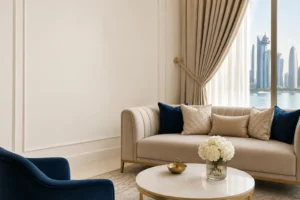
How Doha Home Fix Approaches Custom Sofa and Curtain Work
At Doha Home Fix, custom sofa and curtain making is handled by experienced craftsmen who work across Doha’s diverse residential market — from compact studio apartments in Msheireb to multi-storey villas in Al Gharrafa and Al Waab.
The process starts with a home visit. Rather than asking clients to visit a showroom and choose from preset configurations, the team comes to the property to assess the actual space — measuring ceiling heights, window positions, sightlines, traffic flow, and existing furnishings — before making any recommendations.
Fabric sourcing covers a wide range of options across performance, natural, and luxury categories, with samples brought to the home so clients can see how fabrics look in their actual lighting conditions rather than under showroom lights.
Every build is quoted in detail before work begins. Timelines are confirmed in writing, and installation is handled by the same team that built the pieces — not subcontracted to a third party.
For anyone searching for reliable custom sofa and curtain-making services in Doha, the full service offering is available at https://dohahomefix.com/, with the team reachable directly through the Doha Home Fix Google Maps listing.
Conclusion
Custom sofa and curtain making in Doha is not a niche or luxury service — it is one of the most practical ways to furnish a Qatar home properly. When dimensions do not fit, when light management is a real daily concern, and when the visual weight of a room demands considered choices in fabric and silhouette, a skilled custom workshop delivers results that no retail alternative can match.
The key is choosing the right team — one that measures properly, sources quality materials, communicates clearly, and stands behind what they build.
Ready to Start Your Custom Furnishing Project in Doha?
Whether you need a bespoke sofa built from the frame up, full-length curtains for floor-to-ceiling windows, or both, the Doha Home Fix team is ready to visit your home, assess the space, and give you an honest, detailed quote.
Contact Doha Home Fix today and get your home furnished the right way — built for your space, your climate, and your life in Qatar.
Google Maps: Doha Home Fix Website: https://dohahomefix.com/
Doha Home Fix provides custom sofa making, curtain making, upholstery, carpentry, AC repair, plumbing, and general home maintenance services across Doha and Qatar.
Frequently Asked Questions
How long does custom sofa making take in Doha, Qatar?
A standard custom sofa build typically takes 3 to 5 weeks from fabric confirmation to delivery and installation, depending on complexity and workshop schedule.
What is the best curtain fabric for large windows in Doha?
For large sun-facing windows in Qatar, solution-dyed fabrics with a blackout or thermal lining offer the best combination of light control, fade resistance, and heat management.
Can I change the fabric on an existing sofa in Doha?
Yes. Reupholstering an existing sofa frame — replacing the fabric, foam, and sometimes the suspension — is a cost-effective alternative to buying new, particularly for sofas with solid hardwood frames.