
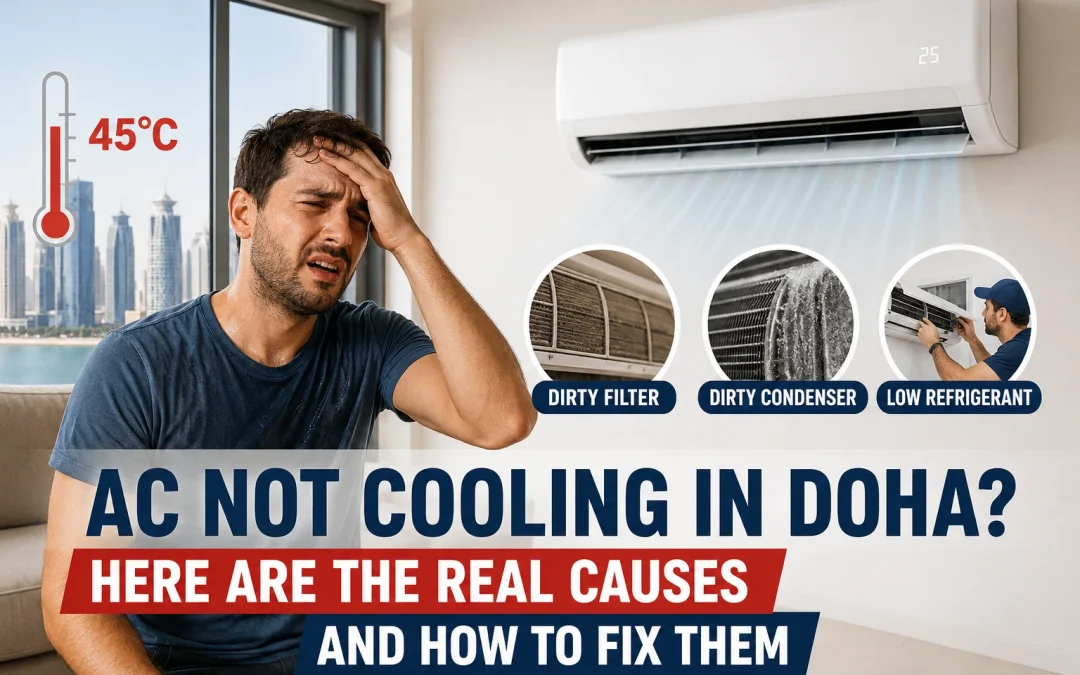
Quick answer: If your AC runs but doesn’t cool in Doha, check three things first — the thermostat is set to Cool (not Fan), the air filter is clean, and the outdoor unit has clear space around it. If cooling doesn’t improve within 30 minutes, the most likely cause is low refrigerant gas, the single most common AC failure in Qatar’s climate. That needs a certified technician. Call +974 7446 9660 for same-day diagnosis anywhere in Doha.
It’s 45°C outside. Your AC is switched on, the fan is blowing — but the room just isn’t getting cool. If this sounds familiar, you’re not alone. It’s the single most common complaint we receive from homeowners and tenants across Doha every summer.
The frustrating part is that an AC running without cooling is more misleading than one that won’t turn on. You assume it’s working because you can feel air coming out. But comfort requires cold air — and when that’s missing, something inside the system has failed.
This guide from the Doha Home Fix technical team walks through what’s actually causing it, what you can safely check yourself in the next ten minutes, what the repair should cost in Qatari riyals, and when you genuinely need a technician. Everything here comes from real callouts our certified technicians handle across Doha every week.
First — What Kind of “Not Cooling” Are You Seeing?
“Not cooling” means different things, and each pattern points to a different fault. Identify yours before calling anyone — it saves diagnostic time and money.
| What you’re seeing | Most likely cause |
|---|---|
| Air blows, but it’s warm or lukewarm | Low refrigerant gas, or a clogged filter |
| Unit runs constantly, room never reaches set temperature | Dirty coils, gas leak, or an undersized unit |
| Cools for a while, then stops | Frozen evaporator coil, or thermal overload |
| Cools fine at night, fails in the afternoon | Unit hitting its maximum ambient temperature rating |
| Some rooms cool, others don’t | Airflow or duct problem |
| Unit doesn’t turn on at all | Electrical fault — a different problem entirely |
What You Can Safely Fix Yourself — and What You Must Not Touch
Before calling anyone, run these checks. Roughly one in four “AC not cooling” calls we receive turns out to be something the homeowner could have fixed in ten minutes.
Safe to do yourself
Check the thermostat mode. Make sure it’s set to Cool (❄), not Fan Only. Set the target temperature below the current room temperature. A unit left in Fan mode is genuinely one of the most common causes of “my AC stopped cooling” calls we get in Doha.
Clean the air filter. In Doha’s dust, filters clog far faster than manufacturers assume — often within four to six weeks during summer. Pull the filter out and hold it to the light. If you can’t see through it clearly, that’s your problem. Wash it with lukewarm water and mild soap, dry it completely, and reinstall. If cooling improves within 20–30 minutes, you’ve found your fault.
Clear the outdoor unit. Your condenser needs at least 50–60cm of clear space on all sides to release heat. Move storage boxes, planters, and debris away from it. We have restored full cooling in Doha apartments simply by clearing a balcony condenser that had been boxed in.
Replace the thermostat batteries if you use a wireless controller.
Never attempt yourself
Refrigerant gas work. Handling refrigerant requires certification and proper recovery equipment. Beyond the legal issue, refrigerant causes frostbite and respiratory harm on contact. And topping up gas without first finding and sealing the leak is wasted money — it will simply leak out again within weeks.
Any electrical repair inside the unit. 230V will kill you. Capacitors also hold a dangerous charge even after the power is switched off.
Compressor work. This is specialist territory, and a botched attempt turns a repairable unit into a replacement.
Checked all three and still no cooling?
The fault is inside the system. Our technicians diagnose it on-site with proper equipment — free diagnosis, upfront quote before any work starts.
The 7 Causes of an AC Not Cooling in Doha
1. Low Refrigerant Gas (The Most Common Real Fault)
Refrigerant is the chemical that actually makes your AC cold. It cycles between the indoor unit and the outdoor compressor, absorbing heat from your room and dumping it outside. When levels drop — almost always from a slow leak — the system loses cooling capacity gradually.
Signs of low refrigerant:
- The room takes far longer to cool than it used to
- A faint hissing or bubbling sound near the indoor unit
- Ice forming on the copper lines or the indoor coil — a clear giveaway
- A rise in your Kahramaa bill with no change in usage
In Qatar’s near-continuous operating conditions, gas leaks develop faster than in temperate climates. This is the fault we diagnose most often in Doha.
What to do: Call a certified technician. They must locate and seal the leak first, then recharge with the correct refrigerant for your unit — R32, R410A, or R22 depending on its age. A technician who simply tops up the gas without finding the leak is taking your money for a repair that won’t last.
2. Dirty or Clogged Air Filter
This is the most overlooked cause, and the one you can genuinely fix yourself.
Your filter traps dust, sand, and airborne debris before they enter the system. In Doha — where shamal dust storms are seasonal and construction dust is year-round — filters clog far faster than the manufacturer’s recommended schedule assumes. A filter rated for three months elsewhere may be fully blocked in six weeks here.
A clogged filter restricts airflow across the evaporator coil. The coil can’t absorb heat from the room air, and what comes out of the vent feels lukewarm at best.
What to do: Clean or replace the filter every 2–4 weeks during peak summer in Qatar. This single habit prevents a large share of the cooling problems we’re called out for.
3. Dirty or Frozen Evaporator Coil
The evaporator coil sits inside your indoor unit and absorbs heat from the room’s air. Over time — and much faster in Doha’s dusty environment — it accumulates a layer of grime that insulates it from the airflow, dramatically reducing its ability to absorb heat.
In more severe cases, restricted airflow (usually from that clogged filter) causes the coil to freeze over entirely, blocking airflow and stopping cooling completely. If you can see ice on the indoor unit, switch the AC off and let it thaw before a technician arrives.
What to do: Professional coil cleaning is part of standard servicing. In Qatar’s conditions, coils should be cleaned at least once a year — ideally in March or April, before the peak heat arrives.
4. Blocked or Dirty Condenser (Outdoor Unit)
Your outdoor unit releases the heat pulled from inside your home. If it’s caked in dust and sand, boxed in by storage, or installed in a poorly ventilated utility space, it can’t release that heat — and the whole cooling cycle backs up.
Outdoor units at ground level or in enclosed service areas are especially vulnerable to sand accumulation after shamal winds. This is a Doha-specific failure mode that generic AC guides never mention.
What to do: Check your outdoor unit after every dust storm. Ensure 50–60cm of clear space on all sides, clear debris, and have it professionally cleaned during annual servicing.
5. Failing Compressor
The compressor is the heart of the system. It sits in the outdoor unit, pressurizes the refrigerant, and drives the entire cooling cycle. When it starts to fail — common in units that have run heavily for several years in Qatar — cooling capacity drops noticeably.
Signs of compressor trouble:
- The AC starts and stops every few minutes (short cycling)
- Loud clicking, grinding, or rattling from the outdoor unit
- The unit runs but never reaches the set temperature, even on a cool night
What to do: This needs a qualified technician. Depending on the unit’s age, repair or replacement will be recommended — and we’ll tell you honestly which makes financial sense.
6. Thermostat Fault or Wrong Setting
Sometimes it really is the simple thing. A misconfigured thermostat, a failed temperature sensor, or a unit accidentally left in Fan Only mode all produce the same symptom: air blowing with no real cooling.
What to check:
- Mode is set to Cool (❄), not Fan
- Target temperature is set below the current room temperature
- Batteries in the remote or wall controller are working
- On smart controllers, check for scheduling conflicts or automation errors
Quick test: Set the AC to 18°C and wait 30 minutes. If nothing changes in cooling intensity, the thermostat isn’t communicating properly with the unit.
7. Undersized AC for the Room
If your unit’s capacity (measured in BTU or tonnage) is too small for the room, it will run continuously and never fully cool the space — no matter how well maintained it is.
This is common in newly rented properties, in rooms that have been extended or converted, and in Qatar’s large open-plan villa layouts. Adding occupants or heat-generating appliances to a room makes an already marginal unit inadequate.
What to do: A technician can calculate the correct BTU for your room’s actual size, sun exposure, and occupancy. Upgrading to a properly sized unit usually costs less over time than running an undersized one at full load every day.
Why ACs Fail Faster in Doha Than Almost Anywhere Else
Your AC in Qatar operates far outside the conditions it was designed and tested for. This context explains why “service it once a year” advice — written for temperate climates — simply doesn’t hold here.
Extreme ambient heat. Outdoor temperatures exceed 45°C from May through September. Many standard AC units are rated to operate only up to 43–46°C ambient. Above that rating, cooling capacity drops sharply and the unit may trip on thermal overload. This is why so many ACs in Doha cool fine overnight but fail in the afternoon — the unit is being pushed past its specification.
Heavy dust and shamal storms. Doha’s dust clogs filters and fouls condenser coils at roughly double the rate of most climates. Homes near active construction — common across Lusail, Al Rayyan, and much of greater Doha — foul even faster.
Near-continuous operation. Many Doha households run AC 18–22 hours a day for five to six months straight. This sustained load accelerates every failure mode: compressor wear, gas leaks, coil fouling, and electrical component fatigue.
High summer humidity. Coastal humidity spiking above 80% in late summer increases the moisture load on the system and raises the risk of drainage blockages and coil freezing.
The practical conclusion: in Qatar, twice-yearly servicing is the realistic minimum, not the annual schedule the manual suggests.

What Does It Actually Cost to Fix in Doha?
Most AC companies in Qatar avoid publishing prices. Vague “QAR 200–800” ranges help nobody budget or spot overcharging. Here is what these repairs genuinely cost in Doha:
| Repair | Typical cost (QAR) | Time |
|---|---|---|
| Diagnosis/inspection visit | 0 – 100 (free if you proceed with the repair) | 30 min |
| Professional service/tune-up | 80 – 150 per unit | 1 hour |
| Gas refill (R32 / R410A / R22) | 150 – 350 | 1 hour |
| Leak detection + seal + gas recharge | 300 – 700 | 2–3 hours |
| Deep coil cleaning | 100 – 250 per unit | 1–2 hours |
| Thermostat replacement | 100 – 300 | 45 min |
| Capacitor replacement | 150 – 300 | 45 min |
| Compressor replacement | 500 – 2,000+ | Half day |
These are realistic Doha figures, not sales bait. Final cost depends on your unit’s brand, age, capacity, and the actual fault found. Always request a written quote before any work begins — from us or from anyone else.
When Repair Stops Making Sense
If your AC is over 8–10 years old and the compressor has failed, replacement is usually the better investment. Continuing to repair an ageing unit in Qatar’s conditions often means paying twice.
We will tell you honestly which side of that line you’re on — even when it means a smaller job for us. If replacement is the right call, our best AC brand guide for Qatar’s heat compares Daikin, LG, and Samsung on the specifications that matter here.
Preventing the Next Failure
The best AC repair is the one you never need. These habits make a real difference in Doha:
- Clean your filter every 2–4 weeks during summer. Set a phone reminder. It’s the single highest-impact thing you can do.
- Book a professional service in March or April, before the peak heat arrives — problems are cheaper to fix when they’re still small.
- Check the outdoor unit after every shamal for sand buildup and blocked airflow.
- Don’t set the thermostat below 20°C. Extreme settings don’t cool the room faster; they stress the compressor and can freeze the coil.
- Check the condensate drain annually. A blocked drain causes water leaks and damages the indoor unit from the inside.
For a full seasonal schedule, read our guide on how to maintain your AC in Doha.
Frequently Asked Questions
Why is my AC running but not cooling in Doha?
The most common cause is low refrigerant gas from a slow leak, followed by a clogged air filter and dirty condenser coils. In Doha’s dust and sustained heat, filters and coils foul unusually fast. Check the filter first — clean it and wait 30 minutes. If cooling doesn’t improve, you likely need professional gas diagnosis.
How much does it cost to refill AC gas in Doha?
Gas refilling in Doha typically costs QAR 150 to 350, depending on refrigerant type and quantity. If there’s a leak, detection and sealing add roughly QAR 150 to 350. Refilling without repairing the leak is wasted money — the gas will escape again within weeks.
Can I refill AC gas myself?
No. Refrigerant handling requires certification and proper recovery equipment, and refrigerant causes frostbite and respiratory harm on contact. Adding gas without sealing the leak first simply delays the failure and costs you twice.
Why does my AC cool at night but not in the afternoon?
This usually means the unit is hitting its maximum ambient temperature rating. Many ACs are rated only to 43–46°C, and Doha regularly exceeds that in peak summer. It can also indicate low refrigerant, which becomes noticeable only under maximum cooling load.
How often should I service my AC in Qatar?
Twice a year is the realistic minimum in Doha — once before summer in March or April, and once mid-season. Units near construction sites or in dusty areas need filter cleaning far more often, roughly every two to four weeks in summer.
Should I repair or replace my AC?
Repair usually makes sense if the unit is under 6–7 years old and the fault is a thermostat, capacitor, or gas leak. Replace it if the compressor has failed on a unit over 8–10 years old, or if you’ve already paid for repeated repairs.
Still Not Cooling? We’ll Diagnose It Today
If you’ve checked the thermostat, cleaned the filter, and cleared the outdoor unit — and your AC still isn’t cooling — the fault is inside the system, and it needs proper diagnostic equipment.
Doha Home Fix provides same-day AC diagnosis and repair across all of Doha, including Lusail, West Bay, The Pearl, Al Sadd, Al Wakrah, and Al Khor. Certified technicians, free diagnosis, an upfront itemised quote before any work starts, and a warranty on every repair.
Call now: +974 7446 9660. WhatsApp us a photo of your unit for instant advice
Related guides:
- AC repair service in Doha — full service details
- AC repair & scrap service in Doha — everything we do
- How to maintain your AC in Doha — prevent this happening again
- Best AC brand for Qatar’s heat — if it’s time to replace
- Sell your old AC in Doha — recover value from a failed unit