
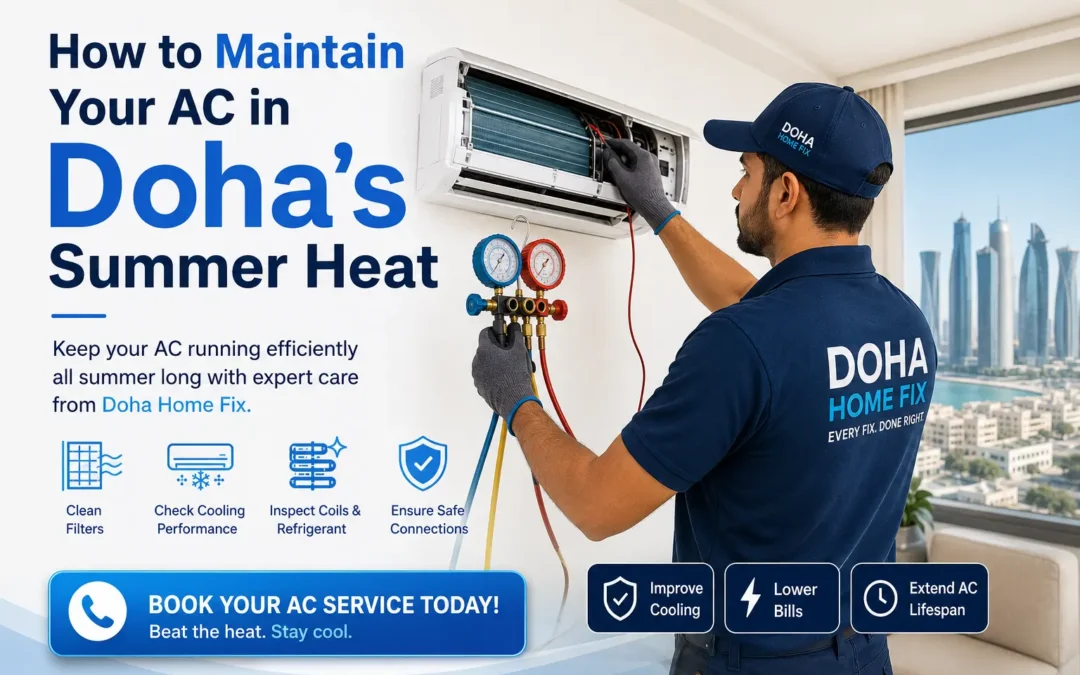
Quick answer: In Doha, clean your AC filter every 2–4 weeks during summer (not every 3 months as the manual says), book a professional service twice a year — once in March/April before peak heat and once mid-season — and keep 50–60cm of clear space around the outdoor unit. These three habits prevent the majority of AC breakdowns in Qatar. For a pre-summer service anywhere in Doha, call +974 7446 9660.
Your AC manual was written for a temperate climate. It tells you to clean the filter every three months and service the unit once a year. In Doha, following that schedule will destroy your AC.
Qatar’s environment is one of the harshest operating conditions for cooling equipment anywhere in the world. Outdoor temperatures exceed 45°C for five straight months. Shamal dust storms load filters with fine sand. Coastal humidity climbs past 80%. And most Doha households run their AC 18 to 22 hours a day, meaning your compressor logs somewhere between 5,000 and 7,000 operating hours a year — several times what a unit in Europe or Southeast Asia would see.
This guide from the Doha Home Fix technical team gives you the maintenance schedule that actually works in Qatar: what to do yourself, when, what it costs, and what to leave to a technician. It’s based on what our certified technicians see across Doha villas, apartments, and compounds every week.
Why Qatar Destroys ACs Faster Than Anywhere Else
Understanding why your AC struggles here explains why the standard schedule fails.
Extreme temperature differential. Your AC has to maintain a 20–25°C gap between indoor and outdoor air. That’s roughly double what units in temperate climates deal with, and the compressor carries that load continuously.
Sand and dust. Filters in Qatar clog three to four times faster than in most countries. Shamal storms are seasonal, construction dust is year-round, and homes near active sites across Lusail and Al Rayyan foul even faster.
Coastal humidity. Doha’s coastal areas see 80–90% humidity in late summer, which strains the dehumidification side of the system and raises the risk of drain blockages and coil freezing.
Salt corrosion. If your property is near the Corniche, The Pearl, or the Lusail waterfront, salt in the air attacks the outdoor unit’s coils and casing. These units need more frequent inspection than inland properties.
Near-continuous operation. Five to six months of near-24-hour running compresses years of wear into a single season.
The practical conclusion: in Qatar, maintenance is not optional upkeep — it is what stands between you and a QAR 2,000 compressor replacement.
Your Doha AC Maintenance Calendar
Here is the schedule that actually matches Qatar’s conditions.
| When | What to do | Who does it |
|---|---|---|
| Every 2–4 weeks (summer) | Clean or replace the air filter | You |
| Monthly (summer) | Check the outdoor unit for sand and debris | You |
| After every shamal storm | Clear sand from the outdoor unit | You |
| March / April | Full professional service before peak heat | Technician |
| July / August | Mid-season check — gas, coils, drain | Technician |
| Annually | Condensate drain flush, electrical inspection | Technician |
| Near coast (Pearl, Corniche, Lusail) | Extra outdoor unit inspection for salt corrosion | Technician |
The single most important date on this calendar is your March or April service. Booking then — before the heat arrives — catches problems while they’re still cheap to fix. Waiting until July means competing with every other household in Doha for a technician, on the hottest day of the year, with a unit that has already failed.
What You Can Do Yourself (And Should)
1. Clean the Air Filter — Every 2–4 Weeks
This is the highest-impact thing you can do, it’s free, and it takes ten minutes.
How to do it:
- Switch the AC off at the wall.
- Open the front panel of the indoor unit — most split units unclip without tools.
- Slide the filter out. Hold it up to the light.
- If you can’t see light clearly through it, that’s your problem.
- Wash with lukewarm water and mild soap. Rinse thoroughly.
- Let it dry completely before reinstalling — a damp filter breeds mold, which is how ACs start to smell.
- Slide it back, close the panel, switch on.
If cooling was weak before, you should notice an improvement within 20 to 30 minutes.
Why this matters so much in Doha: a clogged filter restricts airflow across the evaporator coil. The coil can’t absorb heat, the room stays warm, and in severe cases the coil freezes over entirely. It also forces the compressor to work harder, raising your Kahramaa bill and shortening the unit’s life.

2. Keep the Outdoor Unit Clear
Your outdoor condenser dumps the heat pulled from inside your home. If it’s caked in sand or boxed in, it can’t do that — and the whole cooling cycle backs up.
- Maintain 50–60cm of clear space on all sides
- Move storage boxes, planters, and bags away from it
- Check it after every shamal — fine sand packs into the fins fast
- Gently rinse the outer fins with a hose (power off first). Do not use a pressure washer — you’ll bend the fins and make it worse
We have restored full cooling in Doha apartments simply by clearing a balcony condenser someone had stacked boxes around.
3. Set the Thermostat Correctly
Do not set it below 20°C. A lower setting does not cool the room faster — the AC runs at full capacity either way. All it does is force the compressor to run continuously, waste electricity, and increase the chance of the evaporator coil freezing over.
22–24°C is the efficient range for Doha homes. Every degree lower measurably increases consumption.
4. Check for Water Where There Shouldn’t Be Water
Look at the wall below your indoor unit. Any dripping, staining, or damp patches means the condensate drain is blocked — extremely common in Qatar’s humidity. Left alone, this causes mold growth and wall damage, and can destroy the indoor unit from the inside.
If you see water, switch the unit off and call a technician. The drain flush is a cheap fix; the wall repair is not.
5. Listen to It
A healthy AC produces a consistent low hum. Rattling, clicking, grinding, or buzzing are early warnings. Sounds get worse, never better. A rattle you ignore in May becomes a compressor failure in August, in the middle of a heatwave, when every technician in Doha is booked.
Want it done properly before summer hits?
Our pre-summer service covers coil cleaning, gas check, drain flush, and full electrical inspection — so your AC doesn’t fail on the hottest day of the year.
What a Professional Service Actually Covers
There’s a real difference between someone spraying water on your outdoor unit and a proper service. A genuine AC service in Doha should include:
Deep coil cleaning — both the indoor evaporator and outdoor condenser coils cleaned with proper chemicals, not just hosed down. This is what a homeowner cannot do and what most affects efficiency.
Refrigerant pressure check — gas levels measured and, if low, the leak found and sealed before topping up. A technician who simply adds gas without finding the leak is selling you a repair that will fail again in weeks.
Condensate drain flush — clearing the line that carries away the moisture your AC pulls from the air. Critical in Qatar’s humidity.
Electrical inspection — connections, capacitors, and contactors checked. Capacitors are a common failure point in Qatar’s heat and are cheap to replace before they take the compressor with them.
Fan motor check and lubrication — moving parts inspected for wear.
Airflow and temperature testing — confirming the unit is actually delivering its rated cooling.
If a company quotes you a suspiciously low price, ask which of these six items are included. Usually the answer explains the price.
What Does AC Maintenance Cost in Doha?
Most companies in Qatar won’t publish figures. Here is what a service should realistically cost:
| Service | Typical cost (QAR) |
|---|---|
| Filter cleaning (do it yourself) | Free |
| Professional service/tune-up, per unit | 80 – 150 |
| Deep coil cleaning, per unit | 100 – 250 |
| Condensate drain flush | 80 – 150 |
| Gas top-up (if needed) | 150 – 350 |
| Annual maintenance contract (multi-unit villa) | Varies — usually cheaper per unit |
The Real Cost of Skipping It
This is the calculation most homeowners never run:
- A service costs QAR 80–150.
- A capacitor replacement after a failure costs QAR 150–300.
- A compressor replacement costs QAR 500–2,000+.
- A poorly maintained unit consumes noticeably more electricity every single month it runs — a clean, well-maintained system can use up to 30% less power than a neglected one.
Two services a year in Doha cost less than a single compressor repair. And a well-maintained AC in Qatar routinely lasts years longer than a neglected one.
If your unit has already failed, our guide on why your AC is not cooling in Doha walks through the diagnosis.
Signs You Need a Technician Now — Not Next Month
Stop reading and call someone if you notice any of these:
- Ice on the copper pipes or indoor coil — indicates low refrigerant or serious airflow restriction
- A hissing or bubbling sound near the indoor unit — likely a gas leak
- Water leaking from the indoor unit into the room — blocked drain, and it’s damaging your wall right now
- The unit short-cycling — turning on and off every few minutes
- Grinding or loud clicking from the outdoor unit — compressor or fan fault
- A sharp rise in your Kahramaa bill with no change in usage
- A burning smell — switch the unit off at the breaker immediately; this is an electrical fault
Choosing an AC Maintenance Company in Doha
Not all service companies in Qatar are equal. Before you book anyone:
- Verify they’re licensed — ask for a valid Qatar trade license
- Check they know your brand — technicians should be trained on your specific unit
- Get a written quote before work starts — no exceptions
- Confirm they warranty their work — professional companies stand behind repairs
- Read the Google reviews — for a service business in Doha, anything below 4.5 stars deserves a closer look
- Ask what’s actually included in the service (use the six-point list above)
Frequently Asked Questions
How often should I clean my AC filter in Qatar?
Every 2 to 4 weeks during summer. The 3-month interval in most manuals assumes a temperate, low-dust climate. In Doha’s dust and shamal conditions, filters clog three to four times faster, and a blocked filter is the single most common cause of poor cooling.
How often does an AC need professional servicing in Doha? Twice a year at minimum — once in March or April before peak heat, and once mid-season. Properties near construction sites, or coastal properties exposed to salt air, benefit from more frequent inspection.
What temperature should I set my AC to in Doha?
Between 22°C and 24°C. Setting it below 20°C does not cool the room any faster — the AC runs at full capacity regardless — but it does force the compressor to run continuously, waste electricity, and risk freezing the evaporator coil.
Why is water dripping from my indoor AC unit?
Almost always a blocked condensate drain, which is very common in Qatar’s humidity. The drain line that carries away moisture becomes clogged with dust or algae, and the water backs up into the room. Switch the unit off and have the drain flushed — this is a cheap fix, but the wall damage from ignoring it is not.
Can regular maintenance really lower my electricity bill?
Yes. A clean, well-maintained AC can consume up to 30% less electricity than a neglected one with fouled coils and a clogged filter. In a Doha home running AC 18+ hours a day for five months, that difference is significant over a season.
Does my AC need more maintenance if I live near the sea?
Yes. Properties near the Corniche, The Pearl, and the Lusail waterfront are exposed to salt-laden air, which corrodes outdoor unit coils and casings. These units need more frequent inspection and protective treatment than inland properties.
Book Your Pre-Summer AC Service in Doha
The best time to service your AC in Qatar is March or April — before the heat arrives, while technicians are available, and while small problems are still small.
Doha Home Fix provides AC servicing, deep cleaning, gas checks, and annual maintenance contracts across all of Doha — including Lusail, West Bay, The Pearl, Al Sadd, Al Wakrah, and Al Khor. Certified technicians, transparent pricing, and a warranty on every job.
Call now: +974 7446 9660. WhatsApp us to book a service
Doha Home Fix is a licensed provider of AC repair, maintenance, installation, and scrap services across Doha, Qatar, and a proud subsidiary of New Wall Trading. Lusail Stadium 229, Doha, Qatar. Cost figures reflect typical Doha market rates as of 2026 and real field experience across Qatar’s residential and commercial properties.