
By the Doha Home Fix Plumbing Team | Updated: June 2025 | Reading Time: 7 minutes
It starts with something small. A tap that drips a little more than usual. A drain that takes a few extra seconds to clear. A faint, damp patch on the bathroom wall that you tell yourself is probably just condensation.
Three weeks later, you are standing in two centimetres of water at midnight, calling anyone who will pick up.
Plumbing emergencies in Doha rarely arrive without warning. The warning signs are just easy to ignore — until they are impossible to. The difference between a QAR 150 preventive visit and a QAR 4,000 emergency repair involving burst pipes, ceiling damage to the unit below yours, and a week of disrupted water supply is almost always early action.
This guide gives you six concrete, practical ways to keep that from happening in your home — informed by what the Doha Home Fix plumbing team sees in real call-outs across Qatar’s apartments and villas every single week.
Why Plumbing Emergencies Happen
Before the prevention tips, it is worth understanding why Qatar’s residential plumbing is more susceptible to sudden failure than many homeowners assume.
The water supply itself is a factor. Qatar’s desalinated water is treated with chlorine and other compounds that degrade rubber seals, O-rings, and flexible pipe connectors faster than water from natural groundwater sources. Components that last ten years in Europe may begin to fail in five to six years under Qatar’s supply conditions.
Buildings were constructed quickly. Qatar’s residential property market expanded rapidly through the 2000s and early 2010s. Construction speed and material standards varied considerably. Many apartments across Doha — in areas like Al Sadd, Old Airport Road, and Mansoura — are now fifteen to twenty years old, with original pipework, joints, and fittings that have never been inspected or replaced.
High-occupancy households put systems under sustained pressure. Qatar’s residential apartments often house larger households than the building was designed for. Plumbing systems running at higher-than-intended frequency wear faster — and fail sooner.
Extreme temperature differentials stress pipework. Interiors air-conditioned to 20–22°C while exterior surfaces reach 50°C+ in summer creates significant thermal expansion and contraction cycles in pipework. Over the years, this loosens joints and stresses pipe materials — particularly in poorly supported runs.
Understanding this context explains why prevention is not optional here. It is the difference between managing your home and reacting to it.
- Learn to Read Your Water Meter — and Check It Monthly
This single habit catches more plumbing problems early than any other preventive measure — and almost nobody in Doha does it.
Your water meter records total consumption. A hidden leak — inside a wall, beneath a floor slab, or in a pipe run between your supply point and your fixtures — will register on the meter even when every tap, toilet, and appliance in the apartment is switched off.
How to do it
Turn off every water-using appliance and fixture in your home: taps, washing machine, dishwasher, water heater supply, everything. Locate your water meter — usually in a utility cupboard, outside the front door, or in the building’s common area on your floor — and note the reading. Wait thirty minutes without using any water. Check the reading again.
If the meter has advanced, water is moving through your supply system with everything switched off. That is a leak. It may be minor — a dripping internal toilet cistern valve — or significant — a pressurised supply pipe joint that has begun to fail inside a wall cavity.
Either way, you have caught it before it became visible water damage or a burst.
Check your meter once a month. It takes five minutes and costs nothing. If you are unsure where your meter is located or how to read it, the team at Doha Home Fix can walk you through it during any scheduled service visit.
- Know Where Your Main Stopcock Is — Before You Need It
This sounds basic. You would be surprised how many Qatar apartment residents do not know where their main water shutoff valve is — and discover this fact for the first time while trying to stop water pouring from a burst flexible hose under their kitchen sink.
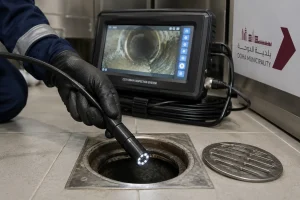
In Doha apartments, the main stopcock — the valve that shuts off water supply to the entire unit — is typically located in one of three places: inside the utility cupboard, beneath the kitchen sink as part of the supply manifold, or outside the front door in a shared service duct. Some older buildings have the unit shutoff valve only accessible from a common meter room on the floor.
Find yours now. Check that it operates smoothly — a valve that has not been turned in years may be stiff or partially seized. Turn it off and on once a year to keep it operational.
In a genuine plumbing emergency, every second between the pipe failing and the water stopping is more water, more damage, and more cost. Knowing where the stopcock is and being able to reach it immediately reduces that damage significantly.
- Check Every Flexible Hose Connection in Your Home
Flexible braided hoses — the short, corrugated metal-sheathed connectors that link your fixed pipework to taps, toilet cisterns, washing machines, and dishwashers — are the most common single cause of sudden, serious water damage in Qatar’s apartments.
They look robust. They are not permanent.
Most flexible hoses are rated for a five to seven-year service life. In Qatar’s conditions — chlorinated water supply, thermal stress, and the vibration of frequently used appliances — real-world lifespan is often shorter. When a flexible hose fails, it does not drip. It lets go. A standard kitchen or bathroom supply hose can discharge the full flow of your water supply — potentially several hundred litres per hour — until someone turns off the stopcock or the building’s supply shuts down.
What to check
Once a year, visually inspect every flexible hose connection in your home. Look for:
- Visible corrosion or discolouration on the metal braiding
- Bulging or swelling anywhere along the hose body
- Moisture, salt deposits, or staining at either end of the connection
- Kinks or sharp bends in the hose run
Any hose showing these signs should be replaced immediately — not scheduled, not noted for later. Replacement hoses are inexpensive. The water damage from a failed hose in a tenth-floor apartment is not.
For a full inspection of every flexible connection in your home, a scheduled preventive plumbing check from Doha Home Fix plumbing services covers this as standard.
- Do Not Ignore Slow Drains
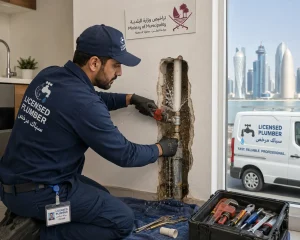
A drain that clears slowly is not a minor inconvenience. It is an early warning that your waste system is narrowing — and that at some point, it will stop clearing altogether.
In Qatar’s apartments, blocked drains escalate in a specific pattern. A bathroom drain becomes slow. The occupant uses a chemical drain product, which provides temporary relief. The underlying blockage — compacted hair, soap residue, and biological matter in the trap and the first section of the waste pipe — remains largely intact and continues to build. Six weeks later, the drain stops working completely, often at a point where wastewater begins to back up into the shower tray or onto the bathroom floor.
If it reaches the point where wastewater is backing up, you now have a hygiene issue as well as a plumbing problem — and if the blockage is in a shared stack serving multiple floors, it affects your neighbours.
The habit that prevents this
Every three months, pour a kettle of boiling water slowly down every drain in your home — bathroom sinks, showers, kitchen sink, and utility room floor drains. Follow it with half a cup of baking soda and half a cup of white vinegar, allow it to work for twenty minutes, then flush with another kettle of hot water. This biological cleaning method maintains drain flow without damaging pipe materials.
If a drain remains slow after this treatment, the blockage is beyond the trap and requires a drain snake or professional jetting to clear properly. Address it then, not three months later when the waste system backs up entirely.
- Service Your Water Heater Before It Fails
Water heaters fail suddenly and completely more often than they fail gradually. One morning, the hot water works normally. The next morning it does not — because an element that has been operating on borrowed time for six months finally gave out overnight.
In Qatar, water heater failures cluster in October and November — the start of the cooler season — because this is when residents begin drawing significant hot water for the first time after months of summer when cool water from the tap was perfectly acceptable. The increased demand on a unit that has been sitting largely idle in extreme ambient heat exposes weaknesses that were not apparent during low-usage months.
What preventive maintenance looks like
Once a year — ideally in September, before the first cool-weather demand spike — arrange a water heater inspection that covers:
Anode rod inspection. The sacrificial anode rod inside your storage tank corrodes to protect the tank lining from the same process. When the anode is fully depleted, the tank lining begins to deteriorate. A competent plumber checks and replaces the anode rod as part of annual heater maintenance.
Tank flush. Draining a portion of the stored water from the drain valve at the base of the tank removes accumulated sediment that reduces heating efficiency and causes premature element failure.
Element and thermostat function check. Confirming that the heating element is drawing correct current and that the thermostat is maintaining the set temperature — typically 55–60°C to prevent bacterial growth — takes minutes and catches failures before they strand you without hot water.
6. Schedule One Preventive Plumbing Check Per Year
This is the one that most Qatar homeowners agree with in principle and never get around to in practice. Life is busy, the plumbing seems fine, and scheduling a visit feels unnecessary until the moment it becomes urgent.
A single annual preventive inspection — covering all visible pipework, flexible connections, drain condition, water heater, toilet cistern components, and tap seal condition — takes a qualified plumber approximately ninety minutes in a standard two or three-bedroom apartment. The cost is a fraction of the cheapest plumbing emergency call-out.
What it catches before they become emergencies: deteriorating flexible hoses, corroded supply fittings, partially blocked drains, early-stage hidden leaks at pipe joints, toilet flappers and fill valves on the verge of failure, and water heater components approaching the end of life.
None of these is dramatic individually. Together, unaddressed, they produce the midnight emergency.
If you are dealing with existing plumbing issues or want a complete picture of your home’s plumbing condition, the Doha Home Fix guide to plumbing problems in Doha is a useful starting point for understanding what to look for and prioritising.

Why Doha Home Fix — and Why It Matters Who You Choose
There is no shortage of plumbers available in Doha. What is genuinely harder to find is a plumbing team that combines technical qualification, honest pricing, consistent availability, and enough real-world experience in Qatar’s specific residential conditions to actually solve the problem rather than apply a temporary fix.
Doha Home Fix has been serving homeowners and tenants across Qatar for years — not as a call centre that dispatches whoever is available, but as a dedicated team that knows the construction standards of Doha’s apartment buildings, understands how Qatar’s water supply affects fittings and components, and carries the tools and parts to complete most jobs in a single visit.
Every technician who arrives at your home is employed by Doha Home Fix — not a subcontractor hired by the job. Every quote is given before work begins, in writing, with no add-ons after the fact. And every completed job comes with a follow-up commitment — if something is not right, the team returns to make it right.
For residents in the areas we serve most frequently — including Lusail, West Bay, The Pearl, Al Sadd, and Al Wakrah — response times are fast, and scheduling is straightforward.
This is what separates a professional plumbing service from a contact list. And in an emergency, that difference is everything.
Conclusion
Plumbing emergencies in Doha are rarely unforeseeable. They are the accumulated result of small warning signs ignored, maintenance deferred, and components left in service well past their reliable lifespan. The six habits covered in this guide — checking your water meter, knowing your stopcock, inspecting flexible hoses, keeping drains clear, servicing your water heater, and scheduling an annual preventive inspection — address the overwhelming majority of causes behind the plumbing emergencies that Doha Home Fix responds to every week.
Prevention is always cheaper than emergency repair. In Qatar’s apartments and villas, it is also more straightforward than many homeowners assume.
Book a Preventive Plumbing Visit With Doha Home Fix
Do not wait for the emergency to find a plumber you trust. The Doha Home Fix team is available across all areas of Qatar for preventive inspections, scheduled maintenance, and emergency call-outs — with honest pricing, qualified technicians, and a commitment to completing the job properly the first time.
Explore the full range of plumbing services at Doha Home Fix or find us directly on Google Maps via our Doha Home Fix listing.
Contact us today — before the problem finds you.
Doha Home Fix provides professional plumbing, AC repair, carpentry, electrical, and general home maintenance services across Doha, Lusail, West Bay, The Pearl, Al Sadd, Al Wakrah, and all areas of Qatar.
Frequently Asked Questions
How much does a preventive plumbing inspection cost in Doha?
A standard preventive inspection for a two to three-bedroom apartment in Doha typically costs between QAR 100 and QAR 250, depending on the scope and the provider. This is significantly less than the minimum call-out cost for an emergency plumbing visit, which typically starts at QAR 200 to QAR 350 outside business hours.
What are the most common signs of a hidden water leak in a Qatar apartment?
The most reliable early indicators are: a water meter that advances with all fixtures turned off, unexplained damp patches on walls or ceilings, tiles that become loose without impact, a persistent musty smell in a dry room, and higher than expected water bills. Any one of these warrants a professional inspection.
Is it worth signing an annual plumbing maintenance contract in Qatar?
For villa owners and long-term residents, yes. An annual maintenance contract covers scheduled preventive visits, priority call-out response, and often discounted rates on parts and labour — making it meaningfully cheaper than paying for emergency call-outs individually. Doha Home Fix offers maintenance contracts for both apartments and villas across Qatar.