
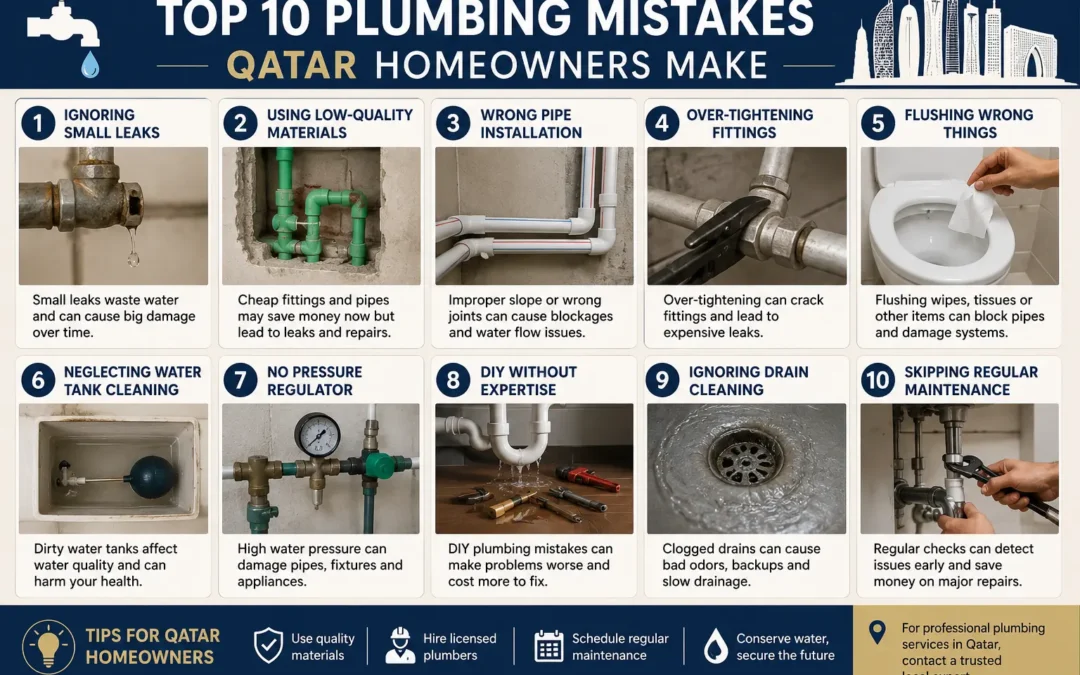
When the Doha Home Fix plumbing team responds to a call-out, the fault itself is rarely the whole story. Behind almost every burst pipe, flooded bathroom, seized stopcock, and failed water heater, there is a decision — made weeks, months, or sometimes years earlier — that set the failure in motion.
Not a bad decision made carelessly. Usually a reasonable-sounding decision made without full awareness of how Qatar’s specific conditions — the water supply chemistry, the building construction standards, the climate extremes — interact with plumbing systems in ways that differ from every other market most residents have lived in before.
These are the ten mistakes that come up most consistently. Knowing them costs nothing to fix. Not knowing them costs considerably more.
Mistake 1: Not Knowing Where the Main Stopcock Is
This is the first mistake, and in emergencies it is the most expensive one.
When a flexible hose fails under a kitchen sink — and in Qatar’s apartments, they do — the difference between a manageable mess and a serious flood is measured in seconds. A 15mm flexible hose running at mains pressure can discharge several hundred litres per hour. Every second between the pipe failing and someone shutting the water off is more water, more damage, and more cost.
A significant proportion of Qatar homeowners — both long-term residents and recent arrivals — do not know where their main water shutoff valve is, or have never checked whether it operates correctly. In Doha’s apartment buildings, the main unit stopcock is typically located inside the utility cupboard, beneath the kitchen sink as part of the supply manifold, or in a shared meter room on the building’s floor landing. In some older developments in Al Sadd and Bin Mahmoud, the valve is only accessible from a common riser cupboard that requires building management to unlock.
Find yours today. Turn it off and on once — a valve that has not moved in years can seize. Know whether it operates smoothly before the moment you urgently need it.
Mistake 2: Using Chemical Drain Cleaners as a Routine Fix
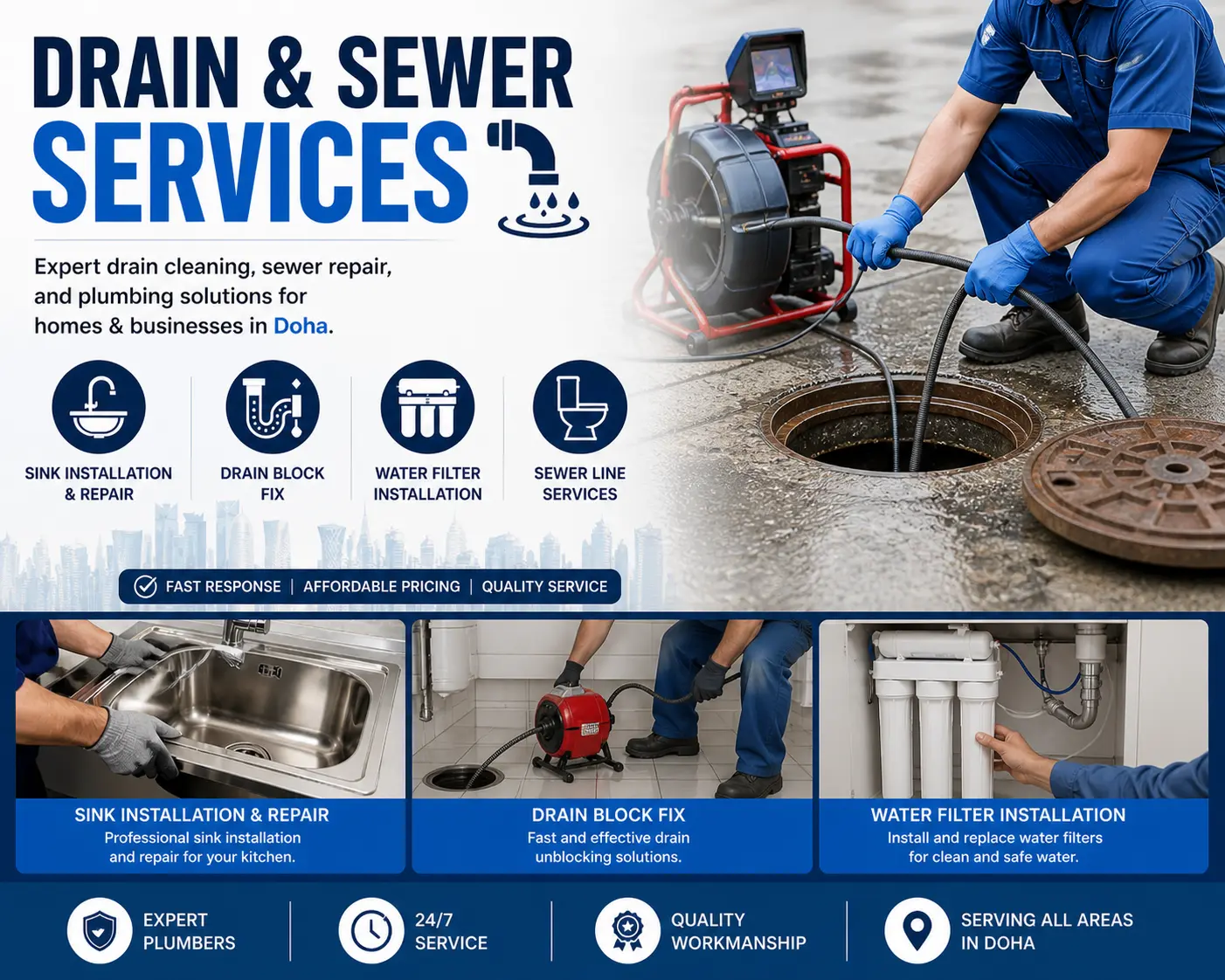
Chemical drain cleaners — the caustic liquid products sold in every Doha supermarket under various brand names — provide fast, visible results on minor organic blockages. This makes them feel like the right solution. For routine maintenance use, they are not.
The caustic compounds in these products (typically sodium hydroxide or sulphuric acid formulations) degrade the rubber seals in P-traps and waste pipe joints over repeated applications. PVC waste pipes — the standard material in Qatar’s apartment buildings — are resistant to occasional chemical contact but not to repeated concentrated exposure. Over years of regular use, the joints in your waste system soften, the seals deteriorate, and what began as a convenient drain cleaner creates the conditions for a waste pipe leak inside the wall cavity.
The correct routine maintenance for Qatar’s drains is a monthly flush of boiling water, followed by baking soda and white vinegar in slow-draining outlets. For a blockage that does not clear with this method, a drain snake or professional jetting is the appropriate tool — not escalating chemical doses.
Mistake 3: Ignoring the First Signs of a Running Toilet
A toilet that continues to run water into the bowl after flushing — audible as a hiss or trickle from the cistern — is wasting water continuously and signalling an internal component failure that will not resolve itself.
The typical cause is a worn flapper valve that no longer creates a complete seal between the cistern and the bowl. Left unaddressed, the constant water movement through the cistern erodes the valve seat over time, eventually requiring replacement of more components than just the flapper. The water cost, though subsidised in Qatar, accumulates — a continuously running toilet can waste 200 litres or more per day.
The flapper valve is a QAR 15–30 component available from hardware stores throughout Doha. Replacement takes under twenty minutes with no specialist tools. Most homeowners who have a running toilet have had it for months before doing anything about it. Most regret the delay when they finally look at what the prolonged water movement has done to the valve seat.
Mistake 4: Never Inspecting Flexible Hose Connections
Flexible braided hoses — the short corrugated connectors linking fixed pipework to taps, toilets, washing machines, and dishwashers — are the single most common cause of sudden, serious water damage in Qatar’s apartments. They look industrial and permanent. They are neither.
Most flexible hoses carry a five to seven year service life rating. In Qatar’s conditions — chlorinated water supply, thermal cycling between heavily air-conditioned interiors and hot building fabric, vibration from appliances — real-world lifespan is often shorter than this. When a flexible hose fails, it does not drip. The internal braiding ruptures under pressure and the fitting lets go, releasing full mains flow into the cabinet beneath your sink or behind your washing machine until someone closes the stopcock.
Once per year, open every under-sink cupboard and check every flexible hose connection in your home. Look for corrosion on the metal braiding, any swelling or bulging along the hose body, staining or salt deposits at the end fittings, and kinks in the hose run. Any of these signs means replace it now, not at a convenient future time.
Mistake 5: Pouring Cooking Grease Down the Kitchen Drain
This is the most predictable cause of kitchen drain blockage in Doha — and the most consistently repeated mistake in the households that call Doha Home Fix for kitchen drain clearing.
Cooking grease poured hot down a drain is liquid in the moment and solid shortly after. As it cools through the waste pipe, it coats the inner wall of the pipe, narrows the bore, and traps food particles and soap residue on its surface. Each subsequent pour adds another layer. The drain narrows progressively over months until the kitchen sink stops clearing entirely.
In Qatar’s apartment buildings, the kitchen drain often connects relatively quickly to the shared soil stack — which means a grease blockage can affect the drainage of multiple fixtures in the property before the kitchen sink itself becomes visibly slow.
The fix is straightforward: collect cooking grease in a container and dispose of it in the bin. A monthly hot water flush of the kitchen drain maintains the pipe bore. Once a grease blockage has established itself deep in the pipe run, professional jetting is the only reliable way to clear it — a service call that costs considerably more than the bin bag the grease should have gone into.
Mistake 6: DIY Repairs to Pressurised Water Supply Pipes
The distinction between waste pipes — which carry water away from fixtures under gravity — and supply pipes — which carry mains-pressure water to fixtures — is one that every homeowner should understand before attempting any plumbing work.
Waste pipe repairs are relatively forgiving. The pipe is not under pressure. A poorly made joint will drip, not spray. The consequences of an imperfect repair are manageable and usually visible before they cause significant damage.
Supply pipe repairs are not forgiving. Mains water pressure in Qatar’s apartment buildings typically runs between 3 and 5 bar. A joint in a pressurised supply pipe that is not correctly made — whether due to inadequate thread sealing, incorrect fitting type, or insufficient torque — will fail under pressure, often inside a wall cavity where the failure is not immediately visible. By the time the damp patch appears on the surface, significant water has already saturated the wall fabric.
Any repair to a pressurised supply line — replacing a section of pipe, installing a new valve, connecting a new appliance to the supply — should be handled by a qualified plumber. The cost of a professional repair is a fraction of the water damage remediation that follows a failed DIY attempt on a pressurised line.
Mistake 7: Skipping the Annual Water Heater Service
Water heaters in Qatar fail more often in October and November than at any other time of year. The pattern is consistent, and the reason is straightforward: these are the first months when residents begin drawing significant hot water after a summer of barely using it. A unit that has been running on reduced demand through the hot months — heating water to temperature but rarely being called upon to deliver it — reveals its weaknesses the moment it is asked to perform under load again.
The anode rod inside a storage water heater corrodes sacrificially to protect the tank lining. When it is depleted, the tank lining begins to corrode instead — leading to internal rust, sediment accumulation at the base of the tank, element overheating, and eventual failure. Replacement of the anode rod is the single most important water heater maintenance task, and the one most consistently skipped because it requires draining and partially disassembling the unit.
Annual water heater servicing — covering anode rod inspection, tank flush, element and thermostat check — should be scheduled in September, before first peak demand of the cool season. Skipping it does not mean nothing happens. It means the consequences arrive at the least convenient moment.
Mistake 8: Ignoring Low Water Pressure Until It Becomes No Water Pressure
Low water pressure in a Qatar apartment is a symptom, not a condition. It indicates that something in the supply system between the building’s main and your fixtures is restricting flow — and that restriction will generally worsen over time, not stabilise.
The most common causes in Doha’s apartment stock are blocked aerators on tap spouts (a simple, free fix — unscrew, rinse, refit), sediment accumulation in the supply pipe bore of older buildings, failing pressure reduction valves, or a building booster pump system that is underperforming.
Homeowners who notice low pressure and do not investigate typically find themselves with complete loss of supply at a later point — when the restriction becomes a full blockage, when the PRV fails completely, or when the pump system trips and does not reset automatically. Catching the cause while pressure is merely reduced, rather than absent, is dramatically simpler and cheaper than addressing the same problem after full failure.
Check your aerators first. If that does not resolve it, report the issue to building management and request a pressure check. If you are in a villa with your own supply connection, a plumber can assess the source of the restriction directly.
Mistake 9: Not Checking the Water Meter for Hidden Leaks
This is the most underused diagnostic tool available to every Qatar homeowner — and it costs nothing to use.
With every water-using fixture and appliance in the property switched off, the water meter should be completely stationary. If it advances — even slowly — water is moving through the supply system with everything closed. That means a leak exists somewhere between the meter and the fixtures. It may be minor (a weeping valve, a dripping internal fitting) or it may be significant (a pressurised supply pipe joint that has begun to fail inside a wall cavity).
Check your meter once a month. Switch everything off, note the reading, wait thirty minutes, check again. This single habit catches hidden leaks before they become visible water damage — and visible water damage in a Qatar apartment almost always means the ceiling below has been affected, which means the neighbor below has been affected, which means the situation is now significantly more complex than a plumbing repair.
If you are facing plumbing problems in Doha and are unsure where to start, the Doha Home Fix guide walks through the diagnostic process step by step.
Mistake 10: Calling Any Available Plumber Rather Than a Qualified One
The final mistake — and the one that compounds all the others — is resolving a plumbing problem by calling whoever answers first, rather than whoever is actually qualified to fix it properly.
Doha has a large informal plumbing market. Individual technicians and small workshops are abundant, response times can be fast, and initial pricing can be low. The problem is not availability — it is accountability. A technician who has not correctly diagnosed the cause of a fault, who uses mismatched components or incorrect sealing methods, or who rushes a repair to get to the next job creates the conditions for a repeat failure — sometimes worse than the original.
A proper plumbing service in Doha starts with a correct diagnosis, proceeds with appropriate materials and methods for Qatar’s specific pipe types and water supply, and is completed with a confirmation of function before the technician leaves. That standard protects you against the second call-out, the water damage, and the repair bill that follows a substandard first attempt.
Doha Home Fix covers all residential areas of Qatar — including Lusail, West Bay, The Pearl, Al Sadd, and Al Wakrah — with qualified plumbers who carry the parts, the tools, and the Qatar-specific experience to fix the problem correctly the first time.
Conclusion
Plumbing problems in Qatar do not usually arrive without warning. They develop — through neglected maintenance, incorrect repairs, and the accumulated effect of small decisions that seemed reasonable at the time. The ten mistakes covered in this guide account for the overwhelming majority of plumbing call-outs the Doha Home Fix team responds to across Qatar’s apartments and villas every week.
Every one of them is avoidable. None of them requires significant time or expense to prevent. The cost of knowledge here is zero. The cost of finding out without it is not.
Frequently Asked Questions
How do I know if I have a hidden water leak in my apartment in Qatar?
Switch off every fixture and appliance, then check your water meter. If the reading advances after thirty minutes with everything off, a hidden leak exists in your supply system. Damp patches, loose tiles, musty smells, and unexplained increases in water bills are secondary indicators.
Is it worth getting a plumbing maintenance contract in Qatar?
For villa owners and long-term apartment residents, yes. An annual maintenance contract with a qualified company covers preventive inspections, priority response, and typically discounted component pricing — significantly cheaper over time than individual emergency call-outs.
What are the most damaging plumbing mistakes in Qatar’s climate specifically?
Ignoring flexible hose condition leads to the most sudden and severe water damage. Skipping water heater maintenance produces the most expensive single-component failures. Routine use of chemical drain cleaner causes the most cumulative long-term pipe degradation. All three are avoidable with basic awareness and modest routine maintenance effort.
Need a Qualified Plumber in Doha?
Whether you need a preventive inspection, a specific fault diagnosed and repaired, or urgent assistance, the Doha Home Fix plumbing team is ready across all areas of Qatar.
Visit https://dohahomefix.com/ for the full service range or find us on the Doha Home Fix Google Maps listing.
Doha Home Fix provides professional plumbing, AC repair, carpentry, electrical, and general home maintenance services across Doha and Qatar.