
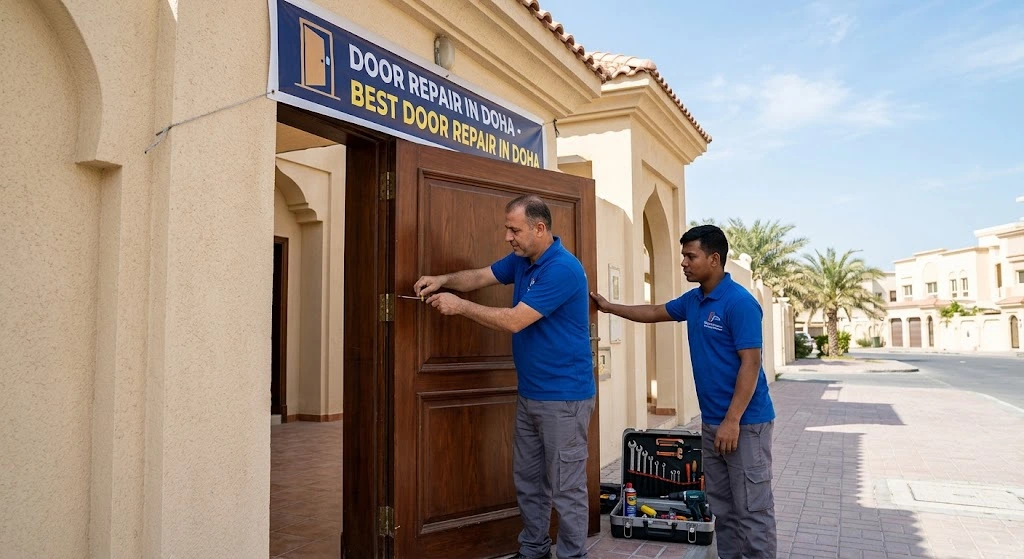
Quick Answer: Most door repairs in Doha cost between QAR 150 and QAR 600. A loose hinge, a sticking door or a worn handle sits at the bottom of that range. A sliding door track, a mortise lock or a swollen wooden door sits at the top. Full door replacement starts around QAR 700 for a flush internal door and runs past QAR 2,000 for a solid main entrance door.
Repair almost always wins if the frame is straight and the door core is solid. Replace when the core is water-damaged, delaminated, or the frame itself has moved.
Three faults account for most of the calls we get in Doha: sticking or binding doors (humidity swelling the timber), sliding door tracks jammed with dust, and handles or locks that have worn out from heavy daily use. All three are repairs, not replacements.
If you want a price for your specific door, send a photo to +974 7446 9660 — the fault is usually identifiable from one picture of the gap between the door and the frame.
Why Doors Fail Faster in Doha Than Almost Anywhere Else
This is the part most door repair pages skip, and it is the part that actually explains your door.
Humidity swells the timber, then the AC shrinks it back
Doha's coastal humidity runs high from May through October. Wooden doors absorb that moisture and expand. Then they sit in a room cooled to 20°C by an AC running most of the day, and they dry out and contract again.
That cycle repeats every day for months. The door that closed perfectly in February starts catching on the frame in July, then rattles loose in January. It is not a badly made door. It is timber doing what timber does in this climate.
What it means practically: if your door sticks only in summer, do not let anyone plane it down in August. Come winter it will have a gap you can see daylight through. The right fix is usually hinge adjustment or a small amount of edge work, done with the seasonal swing in mind.
Dust gets into every sliding track
Fine sand reaches indoors in Doha no matter how well a building is sealed. It settles in sliding door tracks, mixes with the lubricant, and turns into a grinding paste that chews through nylon rollers.
Most "broken" sliding doors in Doha are not broken. They have worn rollers and a track packed with compacted dust. Clean the track properly, replace the rollers, and the door glides again.
AC pressure slams doors harder than people do
Here is one almost nobody mentions. When the AC is running and a window or another door opens, the pressure difference can pull an internal door shut hard. Repeatedly. Over years, that loosens hinge screws, cracks the frame around the strike plate, and splits hollow-core door edges.
If you keep re-tightening the same hinge screws, the screws are not the problem — the door is being slammed by air movement, and it needs a door closer or a soft-stop, not another screw.
Construction pace means the hardware is often the weak point
Qatar has built fast. In a lot of newer apartments the door itself is fine but the ironmongery fitted to it is entry-level. The door will outlast the hinges and the lock by a decade. Upgrading hardware on a good door is cheap; replacing a good door because its hardware failed is not.

The Faults We Actually Get Called For
Ranked roughly by how often the phone rings for each one.
1. The door sticks or rubs on the frame
Usually: humidity swelling, or hinge screws that have loosened and let the door drop. First check yourself: look at the gap around the door. If it is tight at the top on the handle side, the top hinge has probably sagged. If it is tight all the way down the closing edge, it is swelling. Typical fix: hinge adjustment or replacement, sometimes packing behind a hinge leaf. Edge planing only as a last resort, and only in the season it makes sense.
2. Handle loose, floppy, or turns without opening
Usually: the spindle has worn or the latch mechanism inside the door has failed. Typical fix: handle set replacement, or latch cartridge replacement if the handle itself is fine.
3. Lock is stiff, or the key turns but the door does not open
Usually: cylinder wear, or the door has dropped so the bolt no longer lines up with the strike plate. Important: if the door has dropped, replacing the lock does not fix it. The alignment does. Anyone who quotes you a new lock without checking the alignment first has not diagnosed anything. Related: if you are replacing rather than repairing, see our door lock installation in Doha page for lock types and options, or digital and smart lock installation if you are upgrading.
4. Sliding door is heavy, jumps, or comes off the track
Usually: worn rollers plus a dust-packed track. Typical fix: clean and dress the track, replace rollers, re-adjust height. Track replacement only if the track itself is bent or pitted.
5. Door will not stay shut, or bounces open
Usually: the strike plate is misaligned by a few millimetres — often after the frame has shifted, or after the door was repainted and the coat added thickness. Typical fix: strike plate repositioning. This is a genuinely quick job.
6. Hinges squeal
Usually: dry pin, sometimes dust in the knuckle. Do this yourself: a spray lubricant on the hinge pin, worked back and forth. This is not a job worth paying for. If it comes back within weeks, the hinge is worn and needs replacing.
7. Frame is split or the screws no longer bite
Usually: repeated slamming, or a forced entry, or a screw that was over-torqued during installation. Typical fix: frame repair with hardwood dowels and longer screws into solid material, then rehang. Full frame replacement is rare and should be treated as a last resort.
8. Bottom of the door is swollen, dark, or crumbling
Usually: water. A bathroom door, a door near a cleaning route, or a balcony door that has taken rain. This is the one fault that genuinely often means replacement. Once the core has drawn water and delaminated, a repair is cosmetic and it will come back.
What Door Repair Costs in Doha
Almost no door repair company in Qatar publishes prices. Here are ours, so you have a benchmark to hold any quote against — including ours.
| Job | Typical cost (QAR) | Time |
|---|---|---|
| Site inspection and quote | Free | 20–30 min |
| Hinge adjustment / re-tightening | 80 – 180 | 30 min |
| Hinge replacement (per hinge) | 100 – 220 | 30–45 min |
| Handle / lever set replacement | 120 – 300 | 45 min |
| Latch or cylinder replacement | 150 – 400 | 45 min |
| Mortise lock replacement | 250 – 600 | 1–2 hrs |
| Strike plate realignment | 100 – 200 | 30 min |
| Door realignment / rehang | 200 – 450 | 1–2 hrs |
| Door closer supply and fitting | 250 – 500 | 1 hr |
| Sliding door roller replacement | 250 – 600 | 1–2 hrs |
| Sliding door track repair or replacement | 400 – 950 | 2–4 hrs |
| Planing / easing a swollen wooden door | 150 – 350 | 1 hr |
| Frame repair (split or stripped) | 300 – 800 | 2–3 hrs |
| Door panel / skin repair | 350 – 850 | Half day |
| New flush internal door, supplied and fitted | 700 – 1,800 | Half day |
| Solid wood or main entrance door | 2,000 – 6,000+ | 1–2 days |
| Aluminium / glass office door repair | 400 – 1,200 | Varies |
| Fire-rated door repair | Quoted after inspection | Varies |
| Emergency / after-hours callout | +50 – 150 surcharge | — |
What moves the price: the door material, whether the frame needs work as well as the door, access (a 14th-floor apartment with a service-lift booking costs more in time than a villa), and whether you want branded hardware or standard. Ironmongery brand alone can double a lock job.
You always get an itemised written quote before work starts. If the quote says QAR 400, the invoice says QAR 400.
Repair or Replace? The Honest Version
Most companies say "repair" because a repair is the job they are standing in front of. Here is the actual line.
Repair when:
- The frame is square and solid. Open the door halfway and let go — if it stays put, the hinges and frame are fine.
- The core is dry. Press the bottom corners. Firm is good; soft or spongy is not.
- The problem is hardware. Hinges, handles, locks, rollers, and closers are all consumables. Replacing them is normal maintenance, not a sign the door is finished.
- It is a solid or engineered door. These are worth keeping. A good door outlives three sets of hardware.
Replace when:
- The bottom of the door has drawn water and delaminated.
- It is a hollow-core door with a crushed or split edge — there is nothing solid left to screw into.
- The frame itself has moved with the structure, and the door can no longer be squared to it.
- You are changing the security level anyway. If you want a proper security door on a main entrance, retrofitting a heavy lock into a light door does not get you there.
We will tell you which of these you are looking at during the free inspection, including when the answer costs us the job. If it turns out you need a new door rather than a repair, that goes through our door installation and repair service.
[PHOTO: two doors side by side — one repairable, one water-damaged at the base. Alt: "Comparing a repairable door with a water-damaged door core in Doha"]
If Your Building Has Fire Doors, Read This Before You Repair One
This is the section no other door repair page in Doha writes, and it is the one that can cost a business real money.
Fire doors in Qatar are not ordinary doors. They are a certified assembly — door leaf, frame, intumescent seals, hinges, closer, and lock all tested together. The Qatar Civil Defence Department (QCDD), operating under the Ministry of Interior, regulates fire safety across the country under Law No. 9 of 1993, and a valid Civil Defence certificate is tied to your building completion certificate, your Commercial Registration renewal, and your operating licence.
What this means for a damaged fire door:
- A certified fire door carries a permanent label stating its fire rating (commonly 60 or 120 minutes), the test standard it was certified against, and the certifying body. If that label is removed or painted over, the door's compliance becomes very hard to prove at inspection.
- Fitting a non-rated hinge, closer, lock, or vision panel to a fire door invalidates the tested assembly. The door may look fine and still fail an inspection.
- Painting over or removing intumescent seals is a common and expensive mistake. Those seals are what close the gap when the door heats up.
- A propped-open fire door with a wedge is a finding, not a habit.
Practically: if the damaged door is in a corridor, stairwell, plant room, or between a car park and a lobby, assume it is a fire door until you have checked the label. Then have it repaired with certified components, and keep the paperwork — the inspector will ask for it, not just look at the door.
Villas and standalone homes generally do not have fire-rated doors. Apartment towers, offices, retail units, schools, and clinics almost always do.

Renting in Qatar: Who Actually Pays for the Door?
Another question people search for and almost nobody answers.
The short version: in most Qatari residential leases, the landlord is responsible for structural and fixture repairs arising from normal wear, and the tenant is responsible for damage they caused. A door that has swollen with humidity, a hinge that has worn out, a lock that has failed with age — those are normally the landlord's. A kicked-in panel, a lost key requiring a lock change, or a door damaged during your own furniture move — those are normally yours.
Where it gets argued: sliding door rollers and door closers. They are consumables, but they wear over years, so both sides claim the other should pay.
What to do:
- Read the maintenance clause in your tenancy contract. Many Qatar leases specify a small-repair threshold, below which the tenant pays.
- Photograph the fault before anything is touched, with the date visible.
- Get a written quote and send it to the landlord or agent before booking work. A quote in writing settles the argument far faster than a verbal figure.
- Do not deduct the cost from rent unless the contract explicitly allows it.
We give the quote in writing precisely because tenants often need it to send on. Say so when you call and we will format it accordingly.
What You Can Fix Yourself, and What You Should Not
We would rather tell you a job takes five minutes than charge you for it.
Worth doing yourself:
- Lubricate a squealing hinge. Spray the pin, swing the door twenty times. Done.
- Tighten loose hinge screws with a hand screwdriver. If a screw spins without biting, stop — the hole is stripped and needs proper repair, not a longer screw jammed in.
- Clean a sliding track. Vacuum it, then wipe with a damp cloth, then dry it. Do not grease it — grease collects Doha's dust and makes it worse. A dry PTFE lubricant is the right product.
- Check the gap around a sticking door and note where it is tight. Telling us that on the phone saves a visit.
Leave alone:
- Planing a door edge. Take too much off and it cannot be put back, and in Doha you are planing against a seasonal swing you cannot see in the moment.
- Anything on a fire door. See above.
- Frame repairs. A frame repaired badly will fail again and take the surrounding wall finish with it.
- Cutting a new lock mortise. Get it wrong and you have weakened the door exactly where the security is supposed to be.
- Adjusting a door closer's speed valves without knowing which is which. Turning the wrong one fully out can push the arm out of the body.

How to Hire Without Getting Overcharged
Four patterns to watch for in Doha.
A price quoted on the phone before anyone has seen the door. Nobody can diagnose a door from a description. A phone figure that firms up after the technician arrives is not a quote, it is a hook.
A new lock as the answer to a misaligned door. If the bolt is not meeting the strike plate, a new lock changes nothing. Ask what the technician checked before recommending a part.
Charges that appear on the invoice but never on the quote. Transport, consumables, disposal. Ask for the total, in writing, before work begins.
Hardware substitution. You are quoted a branded hinge or cylinder and fitted something else. Ask to see the packaging, and keep it.
For larger work — kitchen doors, wardrobes, built-in units — see our full carpenter services in Doha, or kitchen cabinet and wardrobe work if the doors in question are cabinet fronts rather than room doors.
If the door is electronic and the fault is power rather than mechanism — a keypad that has gone dead, a magnetic lock that will not release — that is usually a supply issue and belongs with our electrical services in Doha.
Areas We Cover
Same-day and next-day door repair across Doha and greater Qatar: Lusail, West Bay, The Pearl, Al Sadd, Al Waab, Al Wakrah, Al Khor, Dafna, Al Rayyan, Msheireb, Najma, Bin Mahmoud, Old Airport, Umm Salal, Abu Hamour, Ain Khaled, Al Gharrafa, Muaither.
Coastal properties — The Pearl, Lusail, West Bay, Al Wakrah — see faster hardware corrosion, so we carry stainless and coated ironmongery as standard for those jobs rather than as an upgrade.
FAQS
What does it cost to repair a door in Doha?
It depends on the damage. Small fixes can start from 150 QAR, and sophisticated fixes can cost much more.
o you carry out any installation work?
Yes. We deal in any type of residential and commercial doors.
Do you carry out large-scale commercial projects?
Yes, we are well equipped to undertake huge-scale office, schools, and retail outlet door installation and repair works.
It depends on the damage. Small fixes can start from 150 QAR, and sophisticated fixes can cost much more.
Yes. We deal in any type of residential and commercial doors.
Yes, we are well equipped to undertake huge-scale office, schools, and retail outlet door installation and repair works.